
Capital inefficiency is the silent killer of decentralized portfolios. In the early days of decentralized finance, borrowing against your assets was a highly fragmented process. If a trader wanted to take out a stablecoin loan, they were forced into “Isolated Margin” vaults.
Under an isolated framework, every single asset in a portfolio operates in a vacuum. If you borrow USDC against your Ethereum, the health of that loan is entirely dependent on the price of Ethereum. Even if you hold millions of dollars in Bitcoin and Solana in your wallet, a sudden drop in Ethereum’s price will trigger a catastrophic liquidation of your ETH position. The system cannot “see” your other wealth.
The institutional standard has now shifted to defi cross margin lending. By unifying a fragmented portfolio into a single, omni-collateralized vault, sophisticated operators are drastically reducing their liquidation risk while simultaneously supercharging their yield-farming APY. Here is the mechanical breakdown of how multi-asset collateralization transforms portfolio architecture.
The Mechanics of Unified Collateral
In a cross-margin protocol, the artificial walls between your assets are torn down. Your entire deposited portfolio—whether it consists of WBTC, ETH, liquid staking tokens (like wstETH), or yield-bearing stablecoins—is aggregated into a single continuous balance sheet.
When you take out a loan, the protocol calculates your account’s global Health Factor using a weighted mathematical formula based on the Loan-to-Value (LTV) parameters of every asset combined:
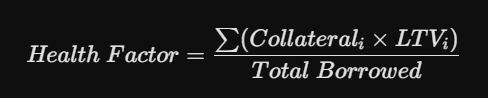
If a sudden market crash causes the value of your Ethereum to plummet, your loan does not immediately default. The retained value of your WBTC and stablecoins mathematically acts as a structural buffer, propping up the global Health Factor and saving the Ethereum position from being liquidated. Your strongest assets automatically defend your weakest assets.
Supercharging APY: The Leverage Flywheel
Beyond pure defensive risk management, defi cross margin lending is utilized offensively to execute highly capital-efficient yield loops.
Because cross-margin accounts recognize the value of all deposited assets simultaneously, traders can utilize yield-bearing tokens as collateral to borrow more assets, compounding their returns:
- Deposit Yield-Bearing Assets: A trader deposits wstETH (which is already earning a 3% staking yield) into the cross-margin vault.
- Borrow Base Assets: Against that wstETH, the trader borrows standard ETH at a low interest rate (e.g., 1.5%).
- Loop and Stake: The borrowed ETH is staked to create more wstETH, which is then re-deposited into the same cross-margin vault, instantly increasing the total collateral value.
- The Net Result: Because the underlying staking yield outpaces the borrowing cost, the trader creates a delta-neutral leverage loop, boosting their net APY to 8% or 10% without ever selling their initial principal or taking on direct fiat price exposure.
The Contagion Risk (The Catch)
Unification breeds resilience, but it also introduces the risk of total contagion.
In an isolated margin setup, your losses are strictly capped. If a highly volatile altcoin you are using as collateral goes to zero, you only lose that specific altcoin vault; the rest of your portfolio is untouched.
In a defi cross margin lending environment, the debt is shared globally. If you include a highly volatile, illiquid token in your cross-margin basket and its price collapses to zero, it will violently drag down the global Health Factor of the entire account. If the Health Factor drops below 1.0, the protocol’s liquidation bots will forcibly sell off your pristine, blue-chip assets (like your Bitcoin and Ethereum) to cover the bad debt generated by the altcoin.
Conclusion: Strict Collateral Hygiene
Cross-margin lending is a professional-grade tool that requires institutional discipline. To safely harness the APY boosts and liquidation buffers of a unified account, operators must practice immaculate collateral hygiene. Never pollute a cross-margin basket with highly speculative tokens. By restricting deposits strictly to deep-liquidity, high-market-cap assets, you can exploit the mathematical efficiencies of decentralized lending without exposing your core wealth to systemic contagion.