Navigating yield generation across decentralized finance during periods of intense market volatility presents a severe operational challenge. Manual yield farming—swapping reward tokens, adjusting liquidity price ranges, tracking money market utilization rates, and rebalancing collateral—is inefficient and costly. In high-volatility regimes, gas price spikes and execution delays frequently turn profitable strategies into net-negative events.
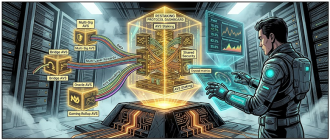
The adoption of automated defi vaults has transformed how institutional allocators and retail liquidity providers manage on-chain assets. Functioning as non-custodial programmatic asset managers, these contracts bundle user deposits, automate harvesting loops, dynamically adjust strategy allocations, and execute circuit breakers when risk metrics cross critical thresholds.
Standardizing Vault Architecture: The ERC-4626 Impact
Prior to standardizing vault design, every yield aggregator built bespoke interfaces for deposits, withdrawals, and share accounting. This fragmentation created severe composability barriers and security integration risks.
The widespread adoption of ERC-4626 (the Tokenized Vault Standard) resolved this fragmentation. ERC-4626 extends the ERC-20 standard to establish a unified interface for yield-bearing vaults. When a user deposits underlying assets (such as USDC or WETH) into an ERC-4626 vault, the contract mints a proportional quantity of vault shares based on the total underlying assets held and deployed by the vault. As the vault generates yield and compounds returns back into the asset pool, the exchange rate increases continuously—allowing share redemption for a larger pool of the underlying asset over time.
Vault Strategies for Volatile Regimes
Different market environments demand specialized risk-adjusted execution strategies. Automated defi vaults deploy capital across four primary architectural models:
1. Concentrated Liquidity Management (AMM Range Optimization)
On platforms like Uniswap V3 or Algebra, liquidity providers must specify concentrated price bands to earn trading fees. In volatile markets, asset prices quickly drift out of range, halting fee collection and exposing position capital to severe impermanent loss. Automated liquidity management vaults utilize off-chain keeper bots or automated solvers to re-center concentrated liquidity ranges dynamically based on volatility indicators (such as Bollinger Bands or implied volatility surfaces), keeping capital productive.
2. Delta-Neutral Cash-and-Carry Strategies
To eliminate directional price risk entirely, delta-neutral vaults hold spot assets while taking an offsetting short position in perpetual futures markets. The vault harvests positive funding rates paid by long traders to short position holders while capturing native staking rewards on the spot leg (e.g., holding stETH spot while shorting ETH perp).
3. Recursive Money Market Looping
In high-demand lending environments, vaults execute automated looping. Capital is deposited into a money market (e.g., Morpho or Aave), borrowed against at a safe Loan-to-Value (LTV) ratio (e.g., 60% LTV), swapped back into the base collateral, and redeposited. This leverage multiplier amplifies base yield while automated risk modules monitor liquidation thresholds 24/7.
4. Intent-Based Cross-Chain Routing
Next-generation yield aggregators utilize intent schemas. Instead of hardcoding linear contract interactions, the vault declares an intended state (e.g., «Maximize stablecoin yield under 5% drawdown constraints»). Solvers compete off-chain to find optimal routing paths across multiple chains and protocols, submitting proof of execution directly to the vault.
Strategy Risk & Performance Matrix
| Vault Strategy | Primary Yield Source | Volatility Sensitivity | Key Operational Risk Vector |
| Lending & Money Market | Borrower interest & utilization fees | Low | Oracle failure & protocol illiquidity |
| Concentrated AMM LP | DEX trading fees & incentive tokens | High | Impermanent loss & rebalancing slippage |
| Delta-Neutral Carry | Funding rate differentials & LST yields | Medium | Negative funding rate flips & basis risk |
| Recursive Looping | Leveraged staking/borrow spreads | High | Liquidation risk during rapid price drops |
Automated Defensive Mechanisms
Operating during market panics requires robust security controls built directly into the vault logic:
- Keeper Bots & Off-Chain Automation: Automation platforms (such as Chainlink Automation or Gelato) continuously monitor on-chain metrics. When gas fees surge or price feeds move beyond normal standard deviation channels, keepers trigger automated rebalances or harvest execution routines.
- Circuit Breakers & Pause Guards: If asset prices drop precipitously or an underlying protocol experiences an anomalous withdrawal spike, emergency modules pause vault interactions and withdraw capital into stable reserve vaults to prevent catastrophic losses.
- Inflation Attack Protections: To prevent early-deposit rounding exploits (where an attacker donates assets to skew share exchange rates in empty vaults), production ERC-4626 implementations deploy virtual shares and virtual assets as offset buffers.
Conclusion
The evolution of automated defi vaults represents the transition of decentralized finance from manual, high-friction yield hunting into sophisticated algorithmic wealth management. By standardizing smart contract interfaces through ERC-4626, leveraging keeper-driven rebalancing loops, and deploying delta-neutral execution frameworks, automated vaults allow capital allocators to maintain high efficiency and harvest real yield across all market regimes.
FAQ
1. What is an ERC-4626 automated vault?
ERC-4626 is a standardized Ethereum token interface for yield-bearing vaults. It unifies how applications interact with vaults, ensuring that depositing, withdrawing, and calculating share values follow a single, secure standard across all DeFi protocols.
2. How do automated vaults protect against impermanent loss?
Vaults managing concentrated liquidity positions use dynamic algorithms to adjust price ranges based on market volatility, automatically rebalancing capital or converting assets to stable reserves when directional trend shifts occur.
3. What is the difference between APR and APY in an automated vault?
APR (Annual Percentage Rate) reflects simple interest earned over a year without compounding. APY (Annual Percentage Yield) accounts for the compounding effect—which automated vaults maximize by continually harvesting rewards and reinvesting them into the principal pool.
4. Can I lose money in a delta-neutral vault?
Yes. While delta-neutral vaults eliminate direct asset price exposure, they remain vulnerable to negative perpetual funding rates, execution slippage during rebalances, smart contract bugs, and liquidations if short positions are improperly collateralized.
5. What fees do automated DeFi vaults typically charge?
Most vaults utilize a dual fee structure: a management fee (typically 1% to 2% annualized of AUM) and a performance fee (typically 10% to 20% of net yield generated), which auto-deducts during compounding events.