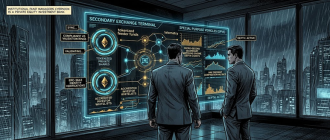
Evaluating rwa crypto projects requires a completely different mindset than trading meme coins or Layer-1 networks. When you buy a traditional cryptocurrency, its value is derived entirely from digital utility, network effects, and speculation.
Real World Assets (RWA) change the math. This sector aims to take the $900 Trillion traditional financial market—real estate, US Treasury bills, corporate credit, and fine art—and represent them as tokens on the blockchain.
BlackRock’s CEO, Larry Fink, has publicly stated that the tokenization of financial assets is the next generation of markets. On Investors Planet, we are tracking this massive institutional shift. However, not all RWA tokens are built the same. Here is the ultimate framework to separate the actual financial bridges from the worthless digital vaporware.
1. The Legal Framework (The Real Moat)
In the RWA sector, code is not law. The law is law.
If a protocol tokenizes a piece of real estate in New York, the smart contract on Ethereum means absolutely nothing if the protocol doesn’t legally own the physical deed in a recognized jurisdiction.
- Red Flag: Projects run by anonymous founders claiming to tokenize gold or real estate. If the protocol gets hacked or goes bankrupt, an anonymous smart contract cannot be taken to court to recover physical assets.
- The Winner’s Trait: Look for projects that use Special Purpose Vehicles (SPVs) or legal trusts (like MakerDAO or Ondo Finance). The tokens must represent a legally binding claim on the underlying asset, recognized by a real-world regulatory body.
2. The Underlying Asset Class (Liquidity is King)
Just because you can tokenize something doesn’t mean you should. The success of an RWA project heavily depends on what exactly they are bringing on-chain.
- Tier 1: US Treasuries and Cash Equivalents. This is currently the most successful RWA sector. Tokenizing T-Bills provides DeFi users with a risk-free, sustainable yield (4-5%) backed by the US Government. It is highly liquid and highly demanded.
- Tier 2: Private Credit and Real Estate. Protocols like Centrifuge allow real-world businesses to use their physical assets (like mortgages or invoices) as collateral to borrow stablecoins. This is incredibly lucrative but carries higher default risk.
- Tier 3: Fine Art and Collectibles. Tokenizing a Picasso painting or a vintage Rolex sounds cool, but these are highly illiquid assets. A fractional token of a watch is difficult to price in real-time and even harder to liquidate during a market crash. Stick to yield-bearing financial instruments.
3. The Oracle Infrastructure
A blockchain is blind. It has no idea what the price of a US Treasury Bill or an ounce of gold is in the real world. To function, an RWA smart contract must rely on an “Oracle” to feed it off-chain data.
- The Vulnerability: If a protocol uses a weak, centralized price feed to price its real-world assets, hackers can manipulate that feed. They can trick the blockchain into thinking the tokenized gold is suddenly worth $1, and buy it all for pennies.
- The Winner’s Trait: Top-tier RWA crypto projects integrate with battle-tested Decentralized Oracle Networks (DONs) like Chainlink. Chainlink provides cryptographic proof of reserves, ensuring that the token minted on the blockchain is actually backed 1:1 by the asset in the real-world bank vault.
4. Value Accrual for the Native Token
This is the most critical question for an investor: Does the project’s native token actually capture the value of the RWA?
Many RWA protocols issue two tokens: the asset token (e.g., a token representing the T-Bill) and the governance token (the crypto token you buy on an exchange).
- The Trap: Often, the protocol generates millions of dollars in yield from the real-world assets, but 100% of that yield goes to the institutional users. The governance token you bought has zero utility other than voting on discord proposals.
- The Solution: You must read the tokenomics. Look for governance tokens that have a “value accrual” mechanism, such as a revenue-sharing model where a percentage of the protocol’s real-world yield is used to buy back and burn the native token on the open market.
Summary: Merging Wall Street and Web3
The boom of rwa crypto projects is the final stage of crypto maturation.
We are moving away from speculative ponzi-nomics toward sustainable, real-world cash flows. When evaluating your next RWA investment, ignore the hype. Audit their legal structure, verify their oracle security, and ensure the token actually captures the financial value of the physical assets they are bringing on-chain. If they pass these checks, you may be looking at the next unicorn of the digital economy.