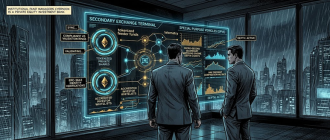
The current state of the Layer 2 (L2) landscape is a paradox. While these networks market themselves as the future of decentralized finance, most of them operate with a massive “God Mode” switch.
If you are using Arbitrum, Optimism, or Base, your transactions are being ordered by a single, centralized entity: the sequencer. This entity is the gatekeeper that determines the order of transactions and submits them to the Ethereum mainnet. On Investors Planet, we recognize that for a project like Fynexis to achieve true institutional-grade status, the underlying infrastructure must move beyond these “training wheels”. A decentralized sequencer is not just a technical upgrade; it is the final step in making L2s as secure and censorship-resistant as the base layers they settle on.
The Hidden Risk: The Centralized Bottleneck
A sequencer is the automated control system of a blockchain. It receives transactions from users, organizes them into a block, and posts the data to Layer 1.
The problem is that if this single sequencer goes offline, the entire network stops. Even worse, a centralized sequencer has a monopoly on Maximal Extractable Value (MEV). Because it sees every transaction before it is finalized, it can front-run your trades or censor specific addresses. For a student at an institution like KhNURE, understanding these control systems is fundamental to building resilient additive manufacturing or financial networks. In a centralized setup, you are trading decentralization for speed – a trade-off that sophisticated investors are starting to reject in 2026.
How Decentralized Sequencers Fix the Flaw
Decentralizing the sequencer involves replacing the single gatekeeper with a distributed network of nodes that must reach consensus on transaction ordering. There are three primary architectures emerging to solve this:
- Shared Sequencing Layers (Espresso, Astria): Instead of every L2 building its own decentralized network, they outsource the task to a shared “sequencing layer.” This allows different L2s to interoperate more effectively, as the same network is ordering transactions for multiple chains simultaneously.
- PoS-based Decentralization: The L2 launches its own validator set where participants must stake tokens to earn the right to sequence blocks. If a sequencer misbehaves or tries to censor transactions, their stake is slashed.
- Lasso and Jolt (ZK-based Ordering): Next-generation protocols are using zero-knowledge proofs to prove that transactions were ordered fairly without revealing the specific contents to the sequencer beforehand, neutralizing the threat of MEV.
The Investor Perspective: Why It Matters for 2026
Institutional capital is no longer satisfied with “decentralization in name only.” As crypto venture capital trends shift toward high-performance infrastructure, the protocols that successfully implement a decentralized sequencer will be the ones that capture real-world asset (RWA) volume.
Wall Street banks and sovereign wealth funds will not deploy billions of dollars into a network that can be turned off by a single server in a data center. By removing the single point of failure, L2s become “uncensorable.” This is the same logic used in advanced additive manufacturing process control: a system is only as strong as its most vulnerable component. Decentralizing the sequencer turns the L2 from a private “sandbox” into a public utility.
Conclusion: Completing the Modular Stack
The transition to a decentralized sequencer represents the completion of the modular blockchain vision.
Ethereum provides the security, data availability layers provide the storage, and decentralized sequencers provide the fair, resilient execution. As we move through 2026, the gap between “centralized” L2s and truly decentralized ones will widen. For those building the next generation of automated financial systems, the choice is clear: the era of the single gatekeeper is ending. If you want to survive the institutional wave, your infrastructure must be as distributed as your ambitions.