The fundamental principle of self-custody in Web3 is absolute control. Cryptography ensures that no government, bank, or malicious actor can confiscate a properly secured wallet. However, this absolute security introduces a catastrophic single point of failure: human mortality.
If an individual passes away or becomes permanently incapacitated without leaving explicit instructions, their digital assets are mathematically locked forever. Passing down a hardware wallet PIN and a 24-word seed phrase to family members or legal counsel requires an immense amount of trust and introduces severe operational security risks. True decentralized finance requires a solution that replaces human trust with mathematical certainty. The institutional standard for digital estate planning is the implementation of a crypto time lock vault.
The Flaw in Traditional Inheritance
In legacy finance, the transfer of wealth upon death is managed by probate courts, lawyers, and custodial banks. In the decentralized economy, relying on physical wills or traditional safe deposit boxes to store private keys defeats the entire purpose of a sovereign asset.
If a written seed phrase is discovered prematurely, the assets can be stolen instantly with no recourse. If a lawyer is tasked with executing a digital will, the estate is entirely dependent on that third party’s honesty and technical competence. A proper digital inheritance architecture must guarantee that beneficiaries receive the assets automatically, at a specific time, without ever exposing the private keys to intermediaries.
The “Dead Man’s Switch” Architecture
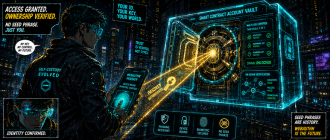
A crypto time lock vault is essentially a smart contract programmed with a “Dead Man’s Switch.” It acts as an autonomous, non-custodial digital vault.
Here is the mechanical execution of a standard time-locked inheritance contract:
- Fund Deposit: The owner deposits their long-term holdings (e.g., WBTC, ETH, or USDC) into a personalized smart contract.
- Defining the Beneficiaries: The contract is programmed with the public wallet addresses of the intended heirs (children, spouses, or charitable DAOs) and the exact percentage of the estate each should receive.
- The Time Lock (The Ping): The smart contract is coded with a strict countdown timer (e.g., 180 days). To prove they are alive and in control, the owner must interact with the contract by sending a zero-value transaction (a “ping”) from their primary wallet before the timer expires. Every time the contract is pinged, the 180-day countdown resets.
- Automatic Execution: If the owner passes away or loses access to their keys, they will fail to ping the contract. Once the 180-day countdown reaches zero, the contract’s secondary functions permanently unlock. The beneficiaries can then execute a function that automatically drains the vault and distributes the assets to their predefined wallets.
Advanced Conditional Triggers
Modern vault architectures are evolving beyond simple time-based countdowns to include multi-signature (Multi-Sig) consensus mechanisms.
In a highly advanced setup, a vault might require both a time lock expiration and decentralized oracle verification. For example, a contract could be programmed to disperse funds only if a specific time has passed AND a trusted decentralized identity protocol verifies an official death certificate data feed. Alternatively, a “Social Recovery” model allows a quorum of trusted guardians (e.g., three out of five family members) to initiate the unlock sequence, which still requires a 30-day waiting period during which the original owner can cancel the action if the guardians are acting maliciously.
Conclusion: Trustless Wealth Transfer
The maturation of decentralized finance demands robust infrastructure for generational wealth transfer.
By utilizing a crypto time lock vault, operators eliminate the anxiety of lost seed phrases and the risks associated with third-party custodians. The blockchain becomes an immutable executor of the estate, guaranteeing that capital flows exactly as intended, completely independent of human intervention. It is the ultimate fusion of cryptography and legacy planning.